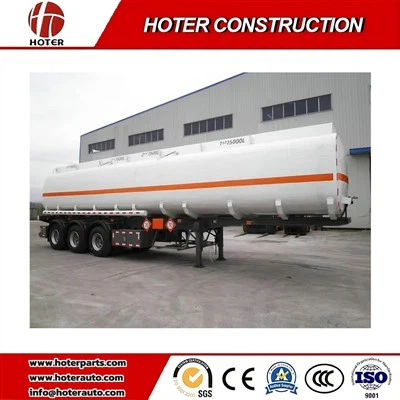
Hey there! I'm a supplier of semi trailers, and today I wanna talk about how to measure the volume of a semi trailer. It's an important thing to know, whether you're a trucker, a logistics manager, or just someone interested in these big rigs.
First off, let's understand why measuring the volume of a semi trailer is so crucial. For truckers, it helps in determining how much cargo they can load safely. Overloading can lead to all sorts of problems, like increased wear and tear on the vehicle, higher fuel consumption, and even legal issues. For logistics managers, it's about optimizing the use of space and making sure they're getting the most out of each shipment.


Now, let's get into the nitty - gritty of measuring the volume. There are different types of semi trailers, and each one has its own way of measuring volume.
Measuring the Volume of a Box Trailer
Most box trailers are rectangular in shape. To measure the volume of a box trailer, you need to measure three things: length, width, and height.
The length is measured from the front to the back of the trailer. Make sure you measure from the inside of the trailer, as the outer dimensions might include the thickness of the walls. Use a tape measure and get an accurate reading.
The width is measured from one side wall to the other, again on the inside. It's important to measure at the widest point, which might not be right at the middle.
The height is measured from the floor to the ceiling. Sometimes, there might be some protrusions or fixtures on the ceiling that you need to take into account.
Once you have these three measurements, you can calculate the volume using the formula: Volume = Length × Width × Height. For example, if a box trailer has a length of 40 feet, a width of 8 feet, and a height of 9 feet, the volume would be 40 × 8 × 9 = 2880 cubic feet.
Measuring the Volume of a 4 Axle Low Bed Trailer
A 4 Axle Low Bed Trailer is a bit different. These trailers are designed to carry heavy and oversized loads. The bed of the trailer is lower to the ground, which makes it easier to load and unload large items.
To measure the volume of a 4 Axle Low Bed Trailer, you first need to measure the length of the flatbed area. This is usually from the front of the bed to the back. Then, measure the width of the bed.
The height measurement for a low - bed trailer is a bit more complex. Since these trailers are used for carrying tall and irregularly shaped items, you need to consider the maximum height that the load can reach. This might involve looking at the clearance under bridges and other obstacles on the route.
The volume of the flatbed part can be calculated as Volume = Length × Width × (average height of the load). However, keep in mind that for low - bed trailers, the load might not fill the entire space evenly, so this is more of an estimate.
Measuring the Volume of a Used Flatbed Semi Trailer
Used flatbed semi trailers are also common in the industry. Measuring their volume is similar to the 4 Axle Low Bed Trailer. You measure the length and width of the flatbed.
The height for a flatbed semi - trailer depends on the type of cargo. If you're carrying a stack of pallets, you need to measure the height of the stack. If it's a single large item, measure the height of that item.
The volume calculation is again based on the formula Volume = Length × Width × Height. But remember, with flatbed trailers, the cargo can be spread out in different ways, so you might need to make some adjustments based on the actual loading pattern.
Measuring the Volume of a Cargo Side Wall Trailer
Cargo side wall trailers are designed to protect the cargo from the elements. Measuring their volume is similar to a box trailer.
Measure the length, width, and height of the interior of the trailer. The side walls add a bit of complexity as they might have some curves or irregularities. You need to measure at the straightest and widest points to get an accurate width.
The volume is then calculated using the same formula as for the box trailer: Volume = Length × Width × Height.
Some Tips for Accurate Volume Measurement
- Use the Right Tools: A good quality tape measure is essential. Make sure it's long enough to measure the entire length of the trailer.
- Measure in the Same Units: Whether you're using feet, meters, or any other unit, make sure all your measurements are in the same unit before calculating the volume.
- Account for Irregularities: If the trailer has any protrusions, slopes, or irregular shapes, try to break the space into smaller, regular shapes and calculate the volume of each part separately, then add them up.
Why It Matters for Us as Suppliers
As a semi - trailer supplier, knowing how to measure the volume is crucial. It helps us provide accurate information to our customers. When a customer is looking for a trailer, they often have specific volume requirements based on the type of cargo they'll be carrying.
We can use the volume calculations to recommend the right trailer for their needs. For example, if a customer needs to transport a large amount of small - sized items, a box trailer with a high volume might be the best choice. On the other hand, if they're carrying heavy and oversized equipment, a 4 Axle Low Bed Trailer would be more suitable.
Conclusion
Measuring the volume of a semi trailer is an important skill for anyone involved in the transportation and logistics industry. Whether you're a trucker, a logistics manager, or a semi - trailer supplier like me, understanding how to measure volume accurately can save you a lot of time, money, and headaches.
If you're in the market for a semi trailer and need more information about volume or any other aspect, don't hesitate to reach out. We're here to help you find the perfect trailer for your needs. Let's start a conversation and see how we can work together to get you the best semi - trailer solution.
References
- Basic geometry textbooks for volume calculation formulas.
- Industry standards and guidelines for semi - trailer design and measurement.